Accelerating Fuel Switch In MFH-Comprehensive Economic Report
 | Florian HabermacherResearcher and Lecturer |
Abstract
This report examines institutional and economic pathways for accelerating the transition from fossil to renewable heating systems in Swiss multi-family buildings. It finds that the market for heat pump installations in this segment is structurally impaired by coordination failures, information asymmetries, high transaction costs, and elevated project-specific risks – barriers that incremental financing improvements or subsidy adjustments alone cannot overcome.
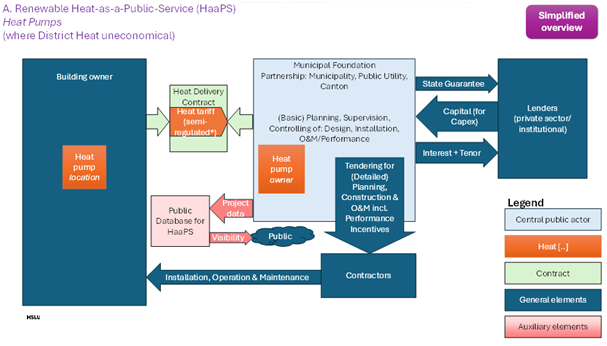
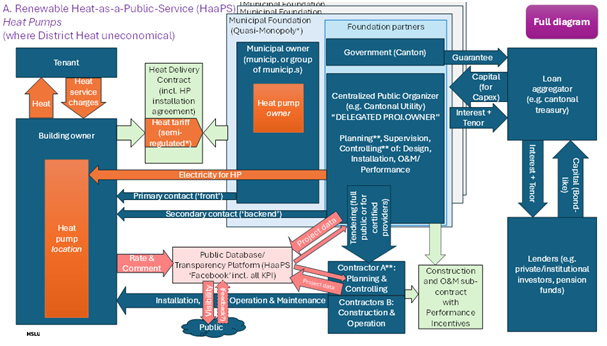
The analysis argues that some form of public sector orchestration is likely necessary if decarbonization is to proceed at the pace required by climate policy objectives. Drawing on the Geneva case, where Services Industriels de Genève (SIG) is developing a Municipal Foundation model in collaboration with cantonal and municipal authorities, the report illustrates how a publicly anchored actor can function as co-orchestrator: performing territorial energy planning, selecting and coordinating engineering firms through competitive tenders, and providing performance guarantees – while allowing the market to organize execution. Shared governance and full transparency toward building owners are identified as essential to the model's legitimacy.
The report develops a decision framework for cantonal adaptation, distinguishing pathways ranging from integrated public orchestration to lighter facilitation models depending on local institutional capacity. Complementary, tentative analysis of electricity system scenarios suggests that large-scale electrification of building heat via heat pumps remains defensible under a wide range of plausible future conditions.
The Municipal Foundation model has not yet been implemented; practical roll-out in Geneva is expected in the course of 2026.
Author: Florian Habermacher